
Historical Seoul High Court's ruling: recognition of same-sex marriage for the first time in Korea!
Updated: Mar 23, 2023
Whether you belong to the LGBTQ+ community yourself or simply advocate for minority rights, you have likely recently heard about an historic decision ruled by the High Court of South Korea: it is a significant milestone for LGBTQ+ rights in Korea and beyond. Let’s explore together how we got here and why this event brings hope for many people.
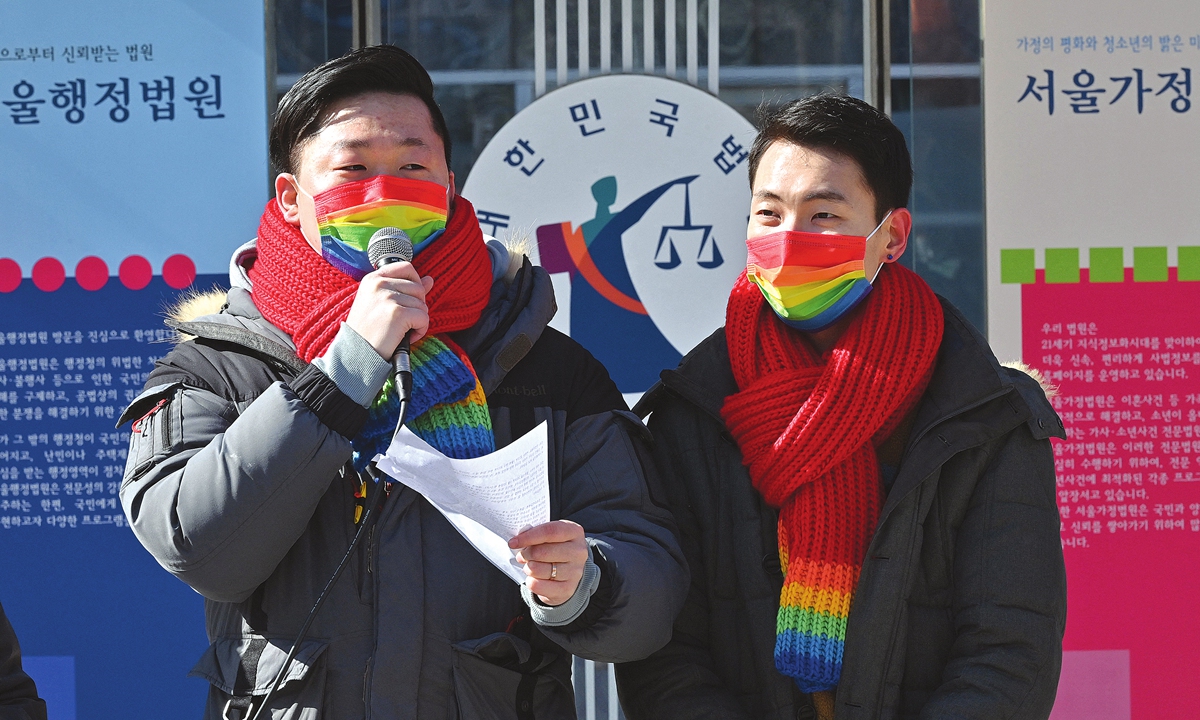
Mr. So Seong-wook and Mr. Kim Yong-Min are a gay couple who have been living together since 2017 and got married in 2019, even though same-sex marriages are not yet recognized by the State.
In order to benefit from a reduction in health insurance fees granted to married couples, one partner is supposed to register as the other’s dependent. To be more specific, this status divides two persons' health insurance fees to only one's. Mr. So and Mr. kim tried to subscribe to this option at the beginning of 2020.
However, in October of the same year, they received an order from the National Health Insurance Service (NHIS) to pay as two independent individuals, on the ground that “ they did not meet the conditions for dependent recognition”. In other words, they were not considered as a married couple by NHIS.
Refusing to pay, they were denied services offered by the company.
This is the reason why, in 2020, the couple initiated a lawsuit in court, against the NHIS, demanding recognition of their dependent status.
The legal proceedings, which lasted over two year, did start badly when the district court ruled :
“Marriage is an union between a man and a woman. A same-sex union is not a common law marriage relationship”.
The court also reminded that the alleged marriage between Mr. So and Mr. Kim is not recognized by the State. Therefore, it is obvious that they should not be recognized as a married couple in the eyes of the health insurance. The court pointed out that “ it is difficult to evaluate the relationship between two persons of the same-sex as a common-law marriage relationship under the current legal system”. Moreover, they added that there is no precedent from any court, or even from societal perspective, where marriage is not only considered to be between a man and a woman. There is no legal basis in Korea affirming that a same-sex couple can be married.
In conclusion, the district court’s final decision was not in favor of the So-Kim couple.
Despite this setback, the couple did not give up and appealed to the High Court, with the help of the organization “The Public Interest Lawyers For Human Rights Law Making Hope”, or simply “Hope Law”.
In the second Instance, the Seoul High Court, presided over by Judge Lee Seung-Han, with Judges Kim Jong-Ho and Shim Jun-Bo, issued a historic decision on February 21th, 2023, in favor of the same-sex couple.
The High Court first chose to change the term “same-sex couple” to “same-sex union partners”. Then, it added that despite being of the same sex, these two individuals have the same characteristics as a married couple under the Korean legal system. Indeed:
“they are living community relationship practically like a common-lax marriage. The common-law marriage, is based on the premise of agreement of mutual intentions regarding the obligations of cohabitation, support, cooperation, and chastity, and the relationship of an emotional and economic life community, such as Mr. So and Mr. Kim’s marriage".
The court’s ruling provided a clear solution to the discrimination faced by the So-Kim couple. The judges decided that the NHIS’s refusal to recognize the couple as dependents was discriminatory on the ground of their sexual orientation. He also emphasized that “although the family and support obligation in the legal sense are the starting point of the dependent system, it cannot be said to be its limit. Anyone can be a minority in some way”.
The lawyer Park Han Hee, who represented the So-Kim couple for “Hope and Law” in this trial, welcomed this decision, saying
“today’s ruling is the first case in which a court has recognized the legal status of same-sex couple".
Mr. Kim, husband of Mr.So, added, “ today, our position in the judicial system has been recognizes and it is a victory for everyone who wants an equal society for same-sex couples”.
(source: Koreatimes)
During this trial, the LGBTQ+ community also showed its support as more than a dozen LGBTQ+ rights supporters showed up in court with rainbow flags and writing such as ‘love’, ‘equality’, ‘family’, and ‘happiness’. “Today’s ruling showed that love conquers discrimination and hatred”.
Now, you might wonder “what is going to happen after this ruling?”.
It should be noted that the High Court of Seoul is not the most important court in South Korea: the supreme Court, called 상고, is competent as the final and highest court in civil, criminal, family, administrative, and military matters. Therefore, it is still possible for the NHIS (defendant) to appeal to the Supreme Court in order to revoke the High Court’s decision. If they wish to, they have a two-week deadline from the day the High-Court gave its decision, until February 7, 2023 to do so.
So far, we have no information on whether the NHIS has appealed in the third instance or not.
Nonetheless, the High Court’s ruling, which has made headlines around the world, has been celebrated by numerous organizations such as Amnesty International, a non-governmental organization that promotes human rights. Its researcher Boram Jang, praised the ruling, stating that:
“this moves bring South Korea closer to achieving marriage equality and offers hope that prejudice can be overcome”.
However, he added on a wiser note that “the country still has a long way to go”...
If you wish to know more about LGBTQ+ community in South Korea, read my article!
It is inspiring to see the couple's persistence and the support they received from their lawyer and the LGBTQ+ community. This ruling is not only a victory for them but also for all those who believe in love, equality, and justice! Btw, What legal avenues are available to the NHIS if they wish to appeal the High Court's decision, and what factors might they consider in making this decision?